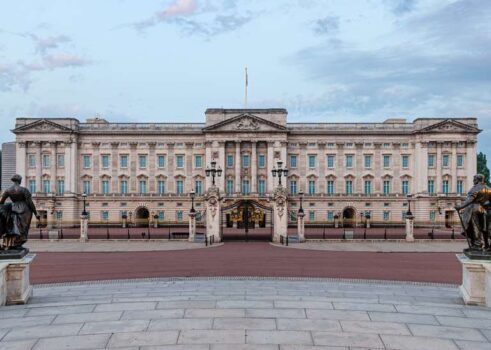
Bookings now open for the 2027 season of public admission. Tickets are normally £35. If you receive support for something long-term or permanent, such as a disability, then worth booking sooner. Else, best to wait much closer to summer.
Offer link: rct.uk/visace .
Highlights: rct.uk/visace .
£1 TICKETS
£1 tickets are available to those on Universal Credit and other named UK means-tested benefits. Check which benefits are eligible. You will need to bring supporting documentation with you on your visit.
£1 tickets are only available for Buckingham Palace visits during August and September (not during July).
You can claim £1 tickets for up to six people per household. Only one person per household needs to show supporting documents, and that person should be part of the visit.
Tickets must be booked in advance to guarantee entry and avoid disappointment. Walk-up tickets are not available.
If you cant find £1 tickets for the date you wish to book, this date is sold out but further dates are available.
Your ticket includes a multimedia guide.
Under 5s tickets and access companion tickets are free.
If you need to add any full-price tickets please book these in a separate transaction.
Those in receipt of the following UK benefits (rct.uk/oneets ):
Universal Credit
Pension Credit
Jobseekers Allowance
Employment and Support Allowance
Working Tax Credit (legacy)
Child Tax Credit (legacy)
Income Support (legacy)
You can claim £1 tickets for up to six people per household. Only one person per household needs to show supporting documents, and that person should be part of the visit.
E.g. A household of six (2 parents & 4 children aged 5) will need to buy 6 x £1 tickets £6 total
HIGHLIGHTS (rct.uk/visace )
Blue Drawing Room
Throne Room
Picture Gallery
Green Drawing Room
Grand Staircase
Palace Garden
Changing the Guard
Treasures of the Palace
The State Rooms
The State Rooms are the public rooms in the Palace where the monarch and members of the Royal Family receive and entertain their guests on State, ceremonial and official occasions. They mainly reflect the taste of George IV, who commissioned the architect John Nash to transform Buckingham House into a grand palace in 1825. The State Rooms are furnished with many of the greatest treasures from the Royal Collection, including paintings by Van Dyck and Canaletto, sculpture by Canova, Sèvres porcelain, and some of the finest English and French furniture in the world.
Many of the State Rooms have served distinctive purposes both in the past and today. The Throne Room is used for court ceremonies and official entertaining, and was the setting for the wedding photos of The Prince and Princess of Wales. The magnificent Blue Drawing Room was originally used as a ballroom until the 1850s, when new rooms were created for Queen Victoria.
Throne Room
The Throne Rooms dramatic arch and canopy over the thrones was the masterpiece of the architect John Nash, and was greatly influenced by his background in theatre set designs.
Central to the room is the pair of throne chairs which are known as Chairs of Estate. They were made for the coronation ceremony of Queen Elizabeth II and Prince Philip in 1953 and were also used for the Coronation of King Charles III and Queen Camilla. You can also see throne chairs made for the coronation of King George V and Queen Mary in 1911, and a single throne chair made for Queen Victoria in 1837.
Picture Gallery
The Picture Gallery inside Buckingham Palace displays some of the greatest paintings in the Royal Collection. Designed to showcase George IVs magnificent paintings collection, the Picture Gallery was part of architect John Nashs transformation of Buckingham House into Buckingham Palace.
Paintings by Rubens, Caravaggio, Vermeer, Rembrandt and Zoffany are among the 120 masterpieces on display. They are broadly grouped according to shared geography, period or subject matter. The paintings displayed are changed regularly, as The King lends many works of art to exhibitions across the UK and overseas.
Today, the Picture Gallery is used by the Royal Family to host guests, including Heads of State, and to hold receptions celebrating members of the public.
Read more about the history of the Picture Gallery
Watch our film and explore the paintings on display in the Picture Gallery
Green Drawing Room
The Green Drawing Room is the first of the Palaces State Rooms designed by the architect John Nash for George IV. Today, it is the setting of official occasions, such as the Diplomatic Reception, where The King welcomes over 500 ambassadors and high commissioners to the Palace.
The room takes its name from the green and gold silk wall coverings installed at the request of Queen Adelaide, wife of William IV. Adelaide suggested that the silk be woven in Ireland to provide employment in one of the countrys poorest areas at the time. Although the wall coverings have been replaced every 30 years or so, they have remained green.
Since the 1760s, when George III acquired Buckingham Palace for his wife, Queen Charlotte, the room has housed many treasures. Today, you can see Allan Ramsays great Coronation portrait of George III, two magnificent Parisian cabinets – one by Adam Weisweiler (Louis XVIs esteemed cabinetmaker) featuring inlaid botanical panels – and the exquisite green Sèvres pot pourri vase purchased by Madame de Pompadour in 1759. Learn more about the vase in the film below.
Grand Staircase
Designed by John Nash and inspired by his experience working in London theatres, the Grand Staircase provides a sense of excitement and expectation for the rooms that follow.
Full length portraits of immediate members of Queen Victorias family decorate the upper part of the staircase. These include her grandparents George III and Queen Charlotte, by Sir William Beechey, her parents the Duke and Duchess of Kent, by George Dawe and Sir George Hayter, and her uncle, William IV, by Sir Thomas Lawrence.
Palace Garden
Features among the 16-hectare garden include the 150 metre herbaceous border, a summer house, rose garden, the enormous Waterloo Vase and the Palace tennis court, where King George VI and Fred Perry played in the 1930s. The garden is best-known as the setting for royal garden parties. The garden can be explored as part of the Summer Opening of the Palace. Read more about the garden today and the people who helped create it.