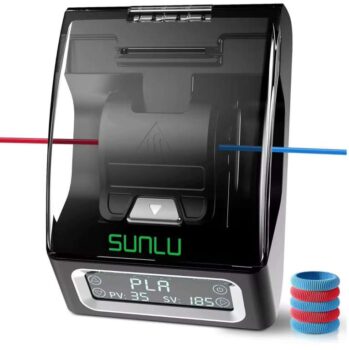
The Core Problem It SolvesAnyone who regularly operates an FDM (Fused Deposition Modeling) 3D printer inevitably accumulates an assortment of partially used spools. As a spool nears its end, the remaining few meters of material pose a dilemma: the leftover strand is often too short to finish a standard model, but throwing it away feels wasteful. If a user tries to print with it anyway, they risk running out mid-print, which can ruin hours of work if the machine does not have an active filament runout sensor.The SUNLU FC01 Filament Connector addresses this issue directly. By allowing users to fuse these random ends together, it creates a single, continuous, and unbroken line of consumable material. This translates to a zero-waste workflow, maximizing filament efficiency and saving money over time.How the Device WorksThe SUNLU FC01 operates as a small, desktop-sized hot plate and clamp system. The typical process flows through a few key mechanical steps:Preparation: The user takes the tail end of one spool and the leading end of another. It is recommended to cut both tips at an identical diagonal angle to maximize the surface area where they touch.Sleeving: The two ends are fed into a small, heat-resistant PTFE (Teflon) tubing sleeve included with the package. This sleeve serves as a structural mold to keep the filament straight and precisely restricted to its uniform 1.75mm diameter baseline.Fusion Heating: The user sets the device to the matching material profile via the front display screen. The built-in heating element rapidly reaches temperatures up to 240C. Once at temp, the clamped core applies heat to melt the intersection. The user gently presses the two strands toward one another inside the hot zone to force a structural bond.Cooling and Post-Processing: After a 10-15 second heat cycle, the bond is left to cool and solidify. The user then utilizes the devices secondary cutting slot to slice away the excess protective sleeve, leaving a clean joint.Material & Creative ApplicationsThe splicer is broadly compatible with mainstream 1.75mm materials, including PLA, ABS, PETG, PCL, PA, and PC. Beyond basic waste reduction, it unlocks a unique creative avenue: DIY multi-color or gradient filaments. By calculating how much material a print job needs for certain layers, a maker can splice distinct color sections onto a single spool. This enables vibrant, multi-colored creations even on basic, single-extruder 3D printers that lack an advanced automatic material switching system.